


Agriculture is usually framed as a sectoral issue—food, land, climate, rural livelihoods.
Precision farming reframes it as something else entirely: a systems problem.
Information, incentives, and infrastructure.
When low-cost sensors, connected devices, and autonomous drones move into fields, farms are not simply being modernized. The decision architecture that governs land, water, labor, and capital begins to change. Agriculture becomes measurable in new ways. Variability becomes visible. Intervention becomes targeted.
What emerges is not just a technological upgrade.
It is a new informational layer for managing food systems.
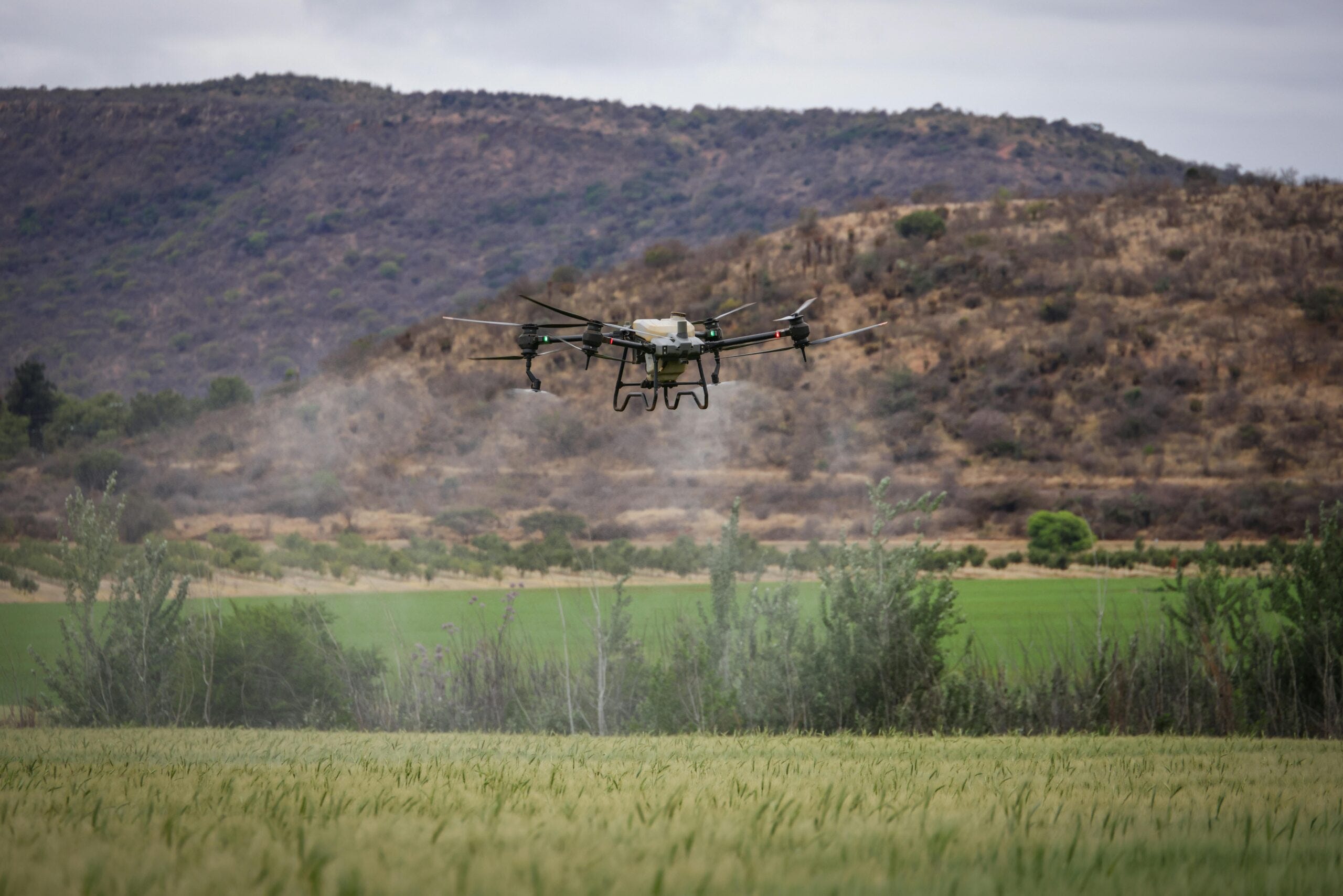
Agricultural drones help farmers monitor crops, detect stress, and support precision farming decisions.
From Gut Decisions to Instrumented Fields
For most of modern agricultural history, decisions have relied on rules of thumb.
Irrigate on a schedule.
Apply fertilizer at standard rates.
Spray pesticides when pests appear.
These heuristics worked reasonably well when inputs were cheap, climate patterns were stable, and environmental externalities were largely ignored.
Precision farming changes the logic.
Instead of treating a farm as a uniform space, it treats the field as a heterogeneous system. Soil properties vary meter by meter. Moisture and temperature shift across microclimates. Pests and diseases spread in spatial patterns rather than evenly across entire fields.
Sensors turn that variability into information.
Soil probes measure moisture levels continuously. Weather stations track local conditions in real time. Nutrient sensors reveal soil chemistry that previously required manual testing.
Drones add a spatial layer to this knowledge. They capture imagery that reveals crop stress, water loss, and emerging disease patterns long before they are visible from the ground.
The farm becomes an instrumented environment.
And the shift is epistemic.
Instead of saying “this field probably needs water,” farmers can ask:
Which zone, under which conditions, benefits from which intervention?
When Sensors Change How Knowledge Works
It is easy to treat agricultural IoT as a collection of gadgets.
But the deeper transformation lies in how knowledge is produced.
Sensors replace occasional measurements with continuous observation. They turn local experience into time-series data that can be revisited, compared, and modeled. Processes that were previously invisible—such as slow soil moisture depletion or nutrient imbalances—become legible.
This matters far beyond individual farms.
Agronomic recommendations can be grounded in real field conditions rather than averages. Insurance models can be calibrated using actual environmental data. Credit systems can incorporate localized risk rather than broad assumptions.
At the same time, these systems raise difficult governance questions.
Who owns agricultural data?
Who has the capacity to analyze it?
Who ultimately benefits from the insights it produces?
Precision farming is not just about sensors.
It is about informational power.
Drones as Spatial Intelligence
Drones extend agricultural sensing into the spatial dimension.
They convert fields into dynamic maps.
Standard RGB imagery allows farmers to inspect crop health and assess damage. Multispectral imaging detects early signs of nutrient deficiency or plant stress. Thermal imaging identifies irrigation inefficiencies and water loss.
But the real power of drones lies in the feedback loop they create.
A drone flight reveals zones of crop stress that might otherwise go unnoticed. Sensor data and historical information are combined with the imagery. Software generates “prescription maps” that guide variable-rate irrigation, fertilization, or pesticide application.
Machinery executes those targeted interventions.
The results feed back into the data.
Agriculture becomes a sensing-decision-action cycle.
In systems terms, drones are not just flying cameras. They are nodes in a feedback loop that can either strengthen human judgment or obscure it, depending on how the system is designed.
Technology and the Redistribution of Power
Precision farming is often marketed as a neutral efficiency upgrade.
It isn’t.
Like many technological systems, it subtly redistributes power.
Platforms that aggregate farm data gain influence over the farmers who generate it. Proprietary analytics systems can create dependencies on vendors whose incentives are opaque. Larger operations may adopt advanced technologies more easily than smallholders, potentially widening existing inequalities.
These dynamics raise policy questions that go well beyond agriculture.
What forms of cooperative data ownership might protect farmers’ autonomy?
How can open standards prevent lock-in to proprietary platforms?
How do we ensure that technological efficiency does not come at the expense of environmental stewardship or rural livelihoods?
Precision farming sits at the intersection of technology, governance, and economic power.
Sustainability Beyond Yield
Most conversations about agricultural technology focus on productivity.
Yield per hectare.
Precision farming can certainly increase yields while reducing wasted inputs. But its more interesting potential lies in what the system is optimized to measure.
Sensors and drones make it possible to manage water use more precisely, reducing pressure on aquifers. Fertilizer applications can be matched to local soil conditions, limiting runoff and emissions. Targeted pest management can reduce chemical use and support biodiversity.
But these benefits are not automatic.
They depend on the metrics institutions choose to prioritize. If systems optimize only for short-term output, environmental gains may remain secondary. If they incorporate soil health, water conservation, and long-term resilience, the same technologies could help build more sustainable agricultural systems.
Precision tools do not resolve these trade-offs.
They make them visible.
Designing Systems That Strengthen Judgment
There is a temptation to see precision agriculture as a pathway toward full automation.
But replacing human judgment with opaque algorithmic recommendations carries its own risks.
Farmers may find themselves following advice generated by models they cannot interrogate, embedded in platforms they cannot easily leave.
A healthier design philosophy treats digital tools as instruments of insight rather than instructions.
Models should remain interpretable. Dashboards should provoke questions rather than dictate actions. Farmers, agronomists, and policymakers should be able to examine the assumptions that guide algorithmic recommendations.
The real promise of precision farming lies in augmenting human judgment.
Not replacing it.
Agriculture’s Emerging Governance Layer
For policymakers and researchers, the most important insight may be this:
Precision farming is becoming infrastructure.
The sensors, data platforms, and mapping tools emerging in agriculture form a new layer through which societies will increasingly govern land use, water resources, emissions, and food security.
The institutional choices made today—about data ownership, interoperability standards, transparency, and accountability—will shape who benefits from these technologies.
They will influence how climate risks are managed.
And they will determine whether rural communities gain new forms of autonomy or lose control to distant platforms.
Drones flying over fields may look like small technological curiosities.
In reality, they are early components of a much larger governance system taking shape around the future of food.